

A recent Duolingo shareholder letter called the app “the world’s most popular way to learn languages”. [1] It's probably a true statement! It's hard to think of a language learning brand with more global recognition than Duolingo and that cute but annoying green owl.
But after Duolingo, there are dozens, and even hundreds of other competing apps in the language learning space. Common names are Babbel, Busuu, Rosetta Stone, Pimsleur, and many others, along with a host of new AI-based competitors. Most of them fall into a few broad groups, and knowing which group an app belongs to tells you a lot about what it will and won't do for you.
We've divided these into four categories here:
- Generalist apps that support many languages
- Single-language apps
- Game-based apps
- AI learning apps
Apps for many languages
Generalist apps may be the best starting point if you have little or no prior knowledge in a language. However, if you are learning a language that is very unlike English, a specialist app may be a better starting point (see below).
Duolingo is the best-known generalist and the most popular language app globally. Babbel, Busuu, and Rosetta Stone work in broadly the same way. Babbel builds its lessons around dialogues, with grammar tips along the way and speech recognition for pronunciation. [2] Busuu teaches 14 languages from A1 to C1 and lets fluent speakers in its community give feedback on your exercises. [3] Rosetta Stone offers up to 25 languages. [4] Pimsleur, another name you'll often hear, covers more than 50 languages with 30-minute audio lessons you listen and respond to, which you can do hands-free, even while driving. [7]
Apps built for one language
Specialist apps focus on a single language. HelloChinese teaches only Chinese, and includes handwriting practice, speech recognition, and native speaker videos. [5] WaniKani focuses on Japanese kanji and related words, and includes about 2,000 kanji and 6,000 vocabulary words. [6] Apps like these are a good resource especially if you are learning a non-Latin based language. Eastern languages have many language features that are unfamiliar to western learners, and a specialized app will typically handle these better than a generalist one.
Apps designed as games
Some apps have taken a more game-based approach, and, to be sure, Duolingo itself has become highly gamified over the years; however, this remains a more niche area in the language learning space. Some notable game-based language learning apps are Wagotabi, Lingo Legend, Noun Town, and WonderLang. Second Language, of course, is also in this game-based niche area. We compared several of these in our roundup of language-learning RPGs.
AI learning apps
Since the advent of ChatGPT and related voice models, there's a new wave of AI-based language learning apps and "language tutors". The vision is obvious: LLMs have expert fluency in all major human languages, and voice models understand and produce native dialog pretty well... One should be able to assemble all these pieces together into a highly personalized, always available language tutor.
Some notable examples in this category are Speak, Praktika, and Langua, among others, and leading generalist apps like Duolingo are adding AI-based features. [1][8][9][10] The strongest advantage of this category is probably the ability to have native-like interactions with minimized fear of failure or embarrassment that comes with real human interactions. This reduces stress which is a key component identified by Stephen Krashen's comprehensible input research. [11]
However, it's unclear to what extent AI tutors will really be able to provide the personalized understanding of a real human language tutor.
The game-based approach of Second Language
I started Second Language based on the vision of an RPG game for which the entire storyline and in-game environment was in a language you are learning... The idea is one part language pedagogy and one part a genuinely fun RPG game. I was inspired by fun RPGs I played as a kid, like Golden Sun, Pokémon and Final Fantasy. In these games, you would spend a lot of time talking to characters, exploring maps, and even reading and learning about history, lore, intrigue, and other plot features.
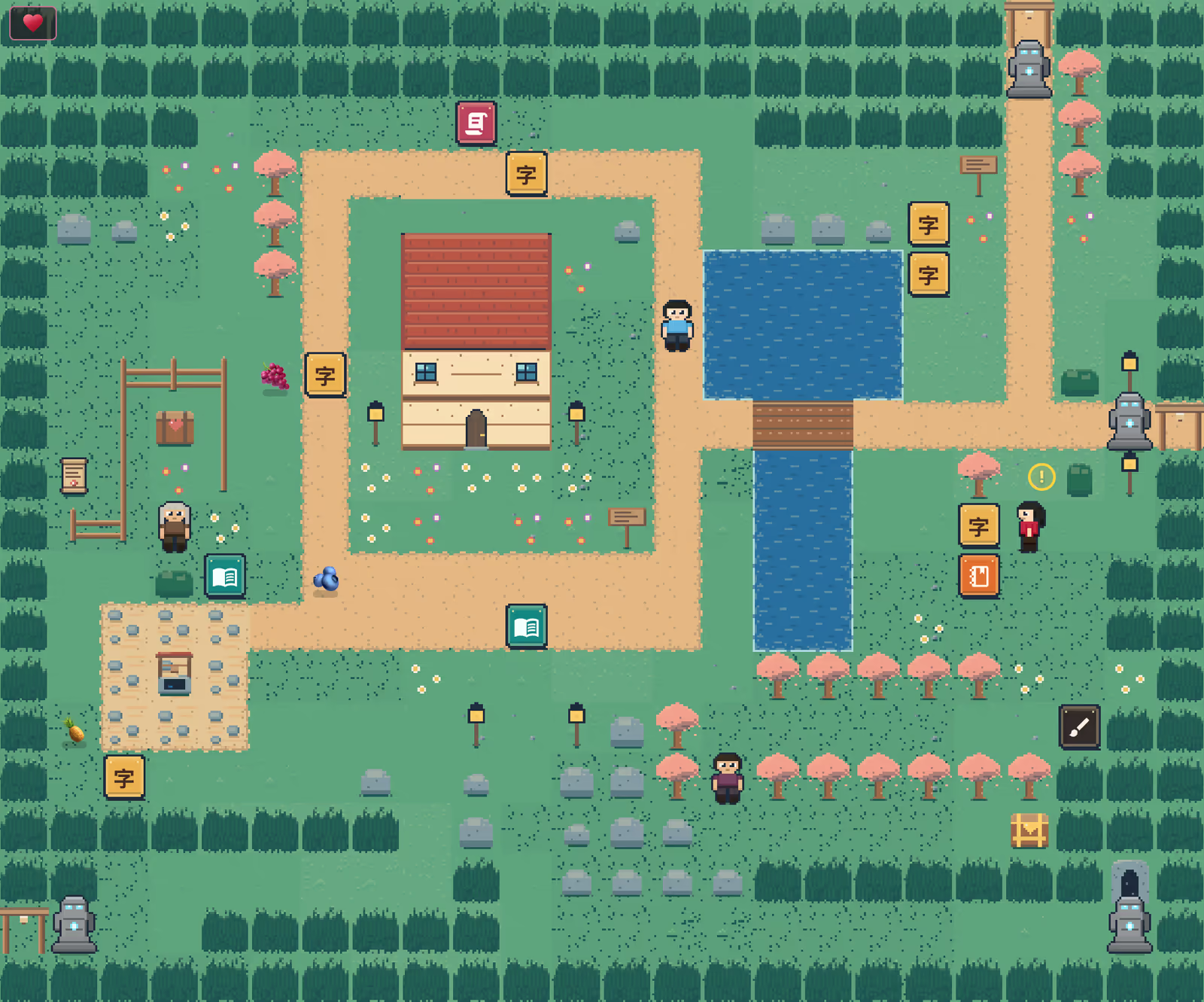
Over time, you would learn quite a lot about the game you were playing... without really trying to learn anything. And the game itself was of course fun and enjoyable to spend time playing.
The vision for Second Language was a synthesis of these experiences centered around language learning. Mastering a new language takes dozens, hundreds... probably a few thousand hours of hard work... If an engaging game experience can get you through the first few hundred hours, well... that is the vision of Second Language! Hopefully it will be your number one language app.
Give it a try and let us know what you think.
Sources
- Second Quarter 2026 Shareholder Letter (Form 8-K, Exhibit 99.2, August 2026)Duolingo, Inc. (SEC filing)
- Learn a Language OnlineBabbel
- Learn Languages OnlineBusuu
- LanguagesRosetta Stone
- HelloChinese: Chinese learning appHelloChinese
- WaniKani: kanji learning applicationTofugu
- Learn New Languages OnlinePimsleur
- Speak: the language learning app that gets you speakingSpeak
- Learn and speak new languages with AI tutorsPraktika
- Meet Langua, the AI language coachLanguaTalk
- Principles and Practice in Second Language AcquisitionKrashen, 1982 (author’s online edition)